
Jorge Zontal, born in Parma, Italy, was a co-founder of the artist collective, General Idea, with Felix Partz and AA Bronson.
General Idea, which was formed in Toronto in 1969, exhibited widely in North America and Europe and was the subject of several retrospectives. Each member took on new names- Felix Partz, born Ronald Gabe, Winnipeg, Manitoba, Canada, 1945-1994. Jorge Zontal, born Slobodan Saia-Levy, Parma, Italy, 1944-1994 and AA Bronson, born Michael Tims, Vancouver, British Columbia, Canada (born 1946).
They lived and worked together, each bringing experience and talent in various media. They produced art in many media that would infiltrate and be inspired by popular culture over 25 years. The group developed a witty, slick-looking form of Conceptual art that borrowed liberally from advertising and other art. They were known for their magazine FILE (1972-1989), their unrelenting production of low-cost multiples, and their early involvement in punk, queer theory, AIDS activism, and other manifestations of the other. In 1974 they founded Art Metropole, Toronto, a distribution center and archive for artists’ books, audio, video, and multiples, which they conceived as the shop and archive for their Gesamtkunstwerk: The 1984 Miss General Idea Pavillion, a kind of meta-museum. From 1987 through 1994 their work addressed the AIDS crisis, with work that included some 75 temporary public art projects. Their major installation, One Year of AZT/One Day of AZT, was featured as a project at the Museum of Modern Art and now resides in the collection of the National Gallery of Canada. General Idea is also well known for its appropriation of Robert Indiana’s colorful “Love” emblem, which it changed to read AIDS.
General Idea exhibited internationally, including solo exhibitions include: Haute Culture: General Idea. Une rétrospective, 1969-1994, Musée d’Art Moderne de la Ville de Paris, Paris and Art Gallery of Ontario, Toronto (2011); FILE Magazine / General Idea Editions, Torpedo Kunstbokhandelen, Oslo (2010); The 1984 Miss General Idea Pavillion, The Art Gallery of York University, Toronto (2009).
Zontal was born in 1944, the son of Yugoslav refugees. He grew up in Caracas, Venezuela, and in 1968 he earned a degree in architecture at Dalhousie University in Halifax, Nova Scotia, where he also studied film making and acting.
Zontal died on February 3, 1994 of AIDS-related causes.
General Idea was dissolved with the deaths of Partz and Zontal in 1994.
(Words taken from Visual AIDS)
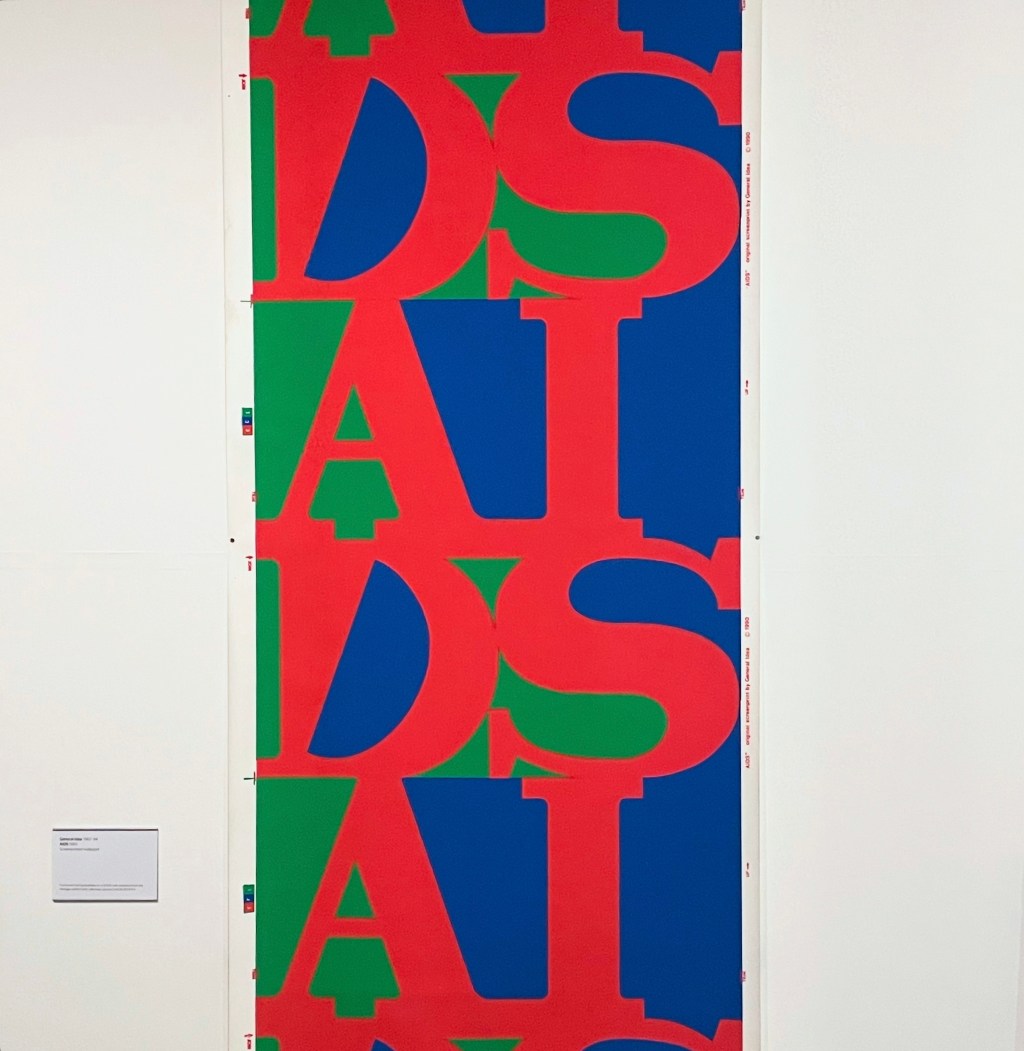
AIDS WALLPAPER from the Whitworth collection.
In the late 1980s the Canadian artists’ collective General Idea designed a wallpaper that was based on Robert Indiana’s famous Love painting from 1966 but with the letters L.O.V.E replaced by A.I.D.S.
General Idea used this logo to promote AIDS-awareness in public places and they printed it on carrier bags and posters as well as on wallpaper. It has been exhibited in many museums and galleries. The adaptation of Indiana’s LOVE motif implies a causal link between the sexual liberation of the 1960s and the sexually transmitted illness that surfaced in the 1980s. One four-letter word replaces another, love mutates into illness and death. The image also gives us a graphic metaphor for the action of the HIV virus itself – the LOVE motif has been infected’ and has mutated from something benign to something dangerous: like the cells invaded by HIV it has kept its form but changed its nature. And by repeating the motif in a wallpaper pattern the artists hint that we might see it as imitating the replication of the HIV virus in the host cells.
But General Idea also intended something more positive when they reproduced this stark acronym as a wallpaper pattern. At the time theyproduced this image, there was widespread ignorance and prejudice surrounding AIDS; phrases such as gay plague was used in the media in a way that implied that those who contracted AIDS were being punished for adopting ‘deviant’ lifestyles. General Idea wanted to
counteract the prevailing tendency either to ignore or to demonize those with HIV or AIDS.
Their avowed intention was simply to normalise the disease as an illness, and not a stigmatizing self-inflicted punishment. Also, by adapting the motif to everyday familiar situations, using homely materials such as wallpaper, they confronted the shame and secrecy imposed on people with AIDS and reminded us that most continue to live ordinary domestic lives.
At the same time, the wallpaper hints at the house-bound routines that a debilitating illness imposes on sufferers: before retroviral drugs controlled the effects of the disease, people with AIDS were often confined at home, with no life outside their own four walls.
(Words taken from the publication Walls are Talking: Wallpaper, Art and Culture)
 Queering The Whitworth
Leave a comment