

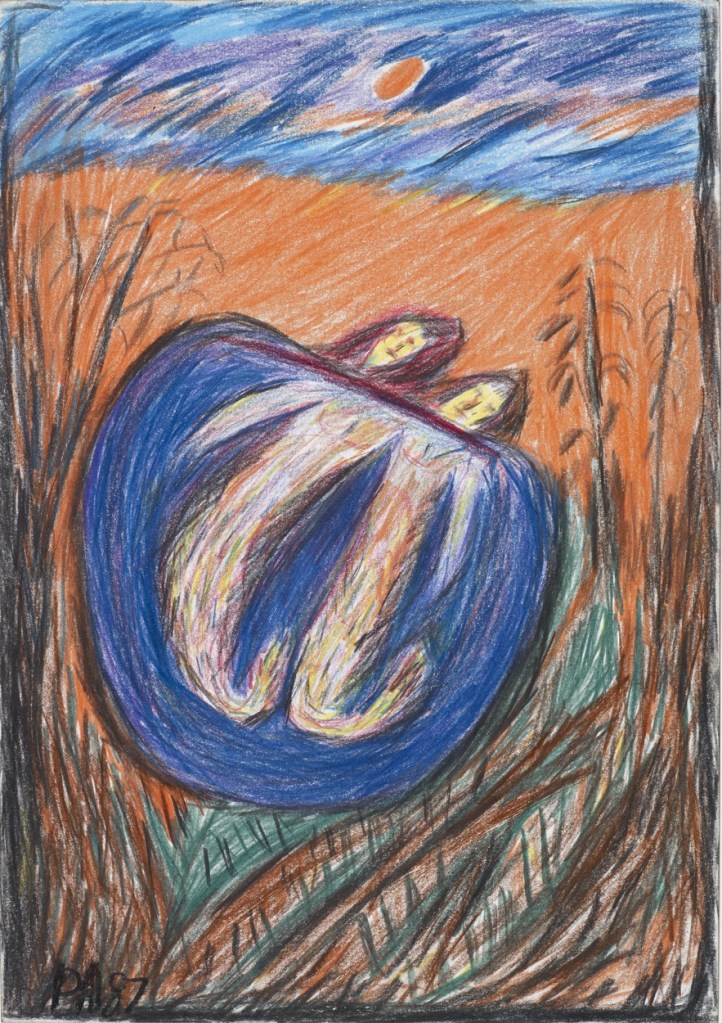
Pearl Alcock, the ‘Black bisexual shebeen queen of Brixton’ moved to the UK from Kingston, Jamaica as part of the Windrush Generation. After saving up money working as a maid, she opened a bridal shop on Railton Road, Brixton, the basement of which soon became a ‘shebeen’, an unlicensed bar that acted as a refuge for the local Black Caribbean queer community in the 70s and 80s. It was much later on, at the age of 50, that she began creating art after being unable to afford a birthday card for a friend. Throughout the rest of her life, she produced over 300 works spanning landscapes, figurative drawings, abstract paintings and sketches, bold visions of colour, pattern and intuitive movement.
This piece, ‘Floating Mermaids’, feels reminiscent to me of the simple joy and beauty of queer companionship and sapphic connection. Of moments of quiet with a lover, under an orange sun, floating through a warm orange field. Encompassed within swirling blue, like the kernel of a seed drifting through a wheat field, the figures seem to hold onto each other dreamily. With tails like mermaids, their bodies are queerly drawn and yet the fluidity and softness of Alcock’s markings and their submersion within the uncomplicated colour palette puts them in harmony with the landscape. It reminds me of lazing with a partner in summer, a kernel of love growing between our bodies, sun on our cheeks, embracing and floating in and out of sleep. There is something so precious about queer rest. Indeed, created in a time and place rife with racism and homophobia, perhaps this piece speaks to this longing for a place of rest and togetherness for marginalised folks, much like the shebeen Alcock herself created.
Written by Ruby Opalka.
Listen to an audio description of Pearl Alcock’s Floating Mermaids, written and recorded by (Un)Defining Queer participant Ruby:
 Queering The Whitworth
Leave a comment