
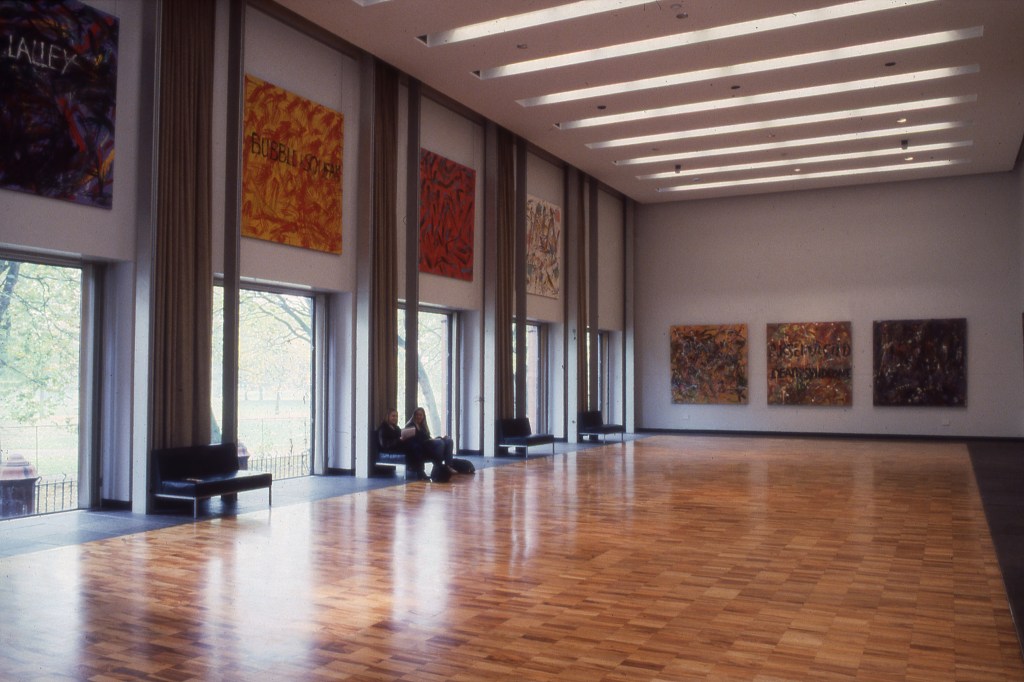
Image courtesy of The Whitworth, University of Manchester.
After the major retrospective Derek Jarman PROTEST! at Manchester Art Gallery (December 2, 2021 – April 10, 2022) it is worth remembering the artist’s last exhibition Evil Queen at the Whitworth Art Gallery (September 8– November 5, 1994), made in collaboration with Granada Television and Boddington. Jarman never got to see the exhibition because of his untimely death caused by an AIDS-related illness on 19 February 1994.
Evil Queen exhibited sixteen of the seventeen paintings that the artist made with the help of his assistant Karl Lydon in 1993, the painting missing being Ataxia – Aids is Fun which at the time was on exhibition at the Tate Modern. The exhibition takes the name from one of the paintings on display. The paintings are all large canvases, characterised by thick streaks of colourful oil paint with words and slogans written into the paint which often makes it hard to distinguish from the saturated backdrop. The underlying themes that characterise the paintings are both personal to Jarman and political to the wider community: the slogans and words written in paint allude to the artist’s AIDS related conditions such as his reduced eyesight (Fuck Me Blind) and ataxia, the loss of full control of bodily movements (Dizzy Bitch). The paintings are also significant for their defiant slogans and raising awareness of the realities of living with AIDS in a society where AIDS was surrounded by deep homophobic stigma. It is therefore significant how since his public statement of his HIV positive diagnosis in 1986, he remained an AIDS activist throughout his life up until his death in February 1994. Jarman was a pioneer in AIDS activism in the 1980s and his impact remains relevant to today’s activists.
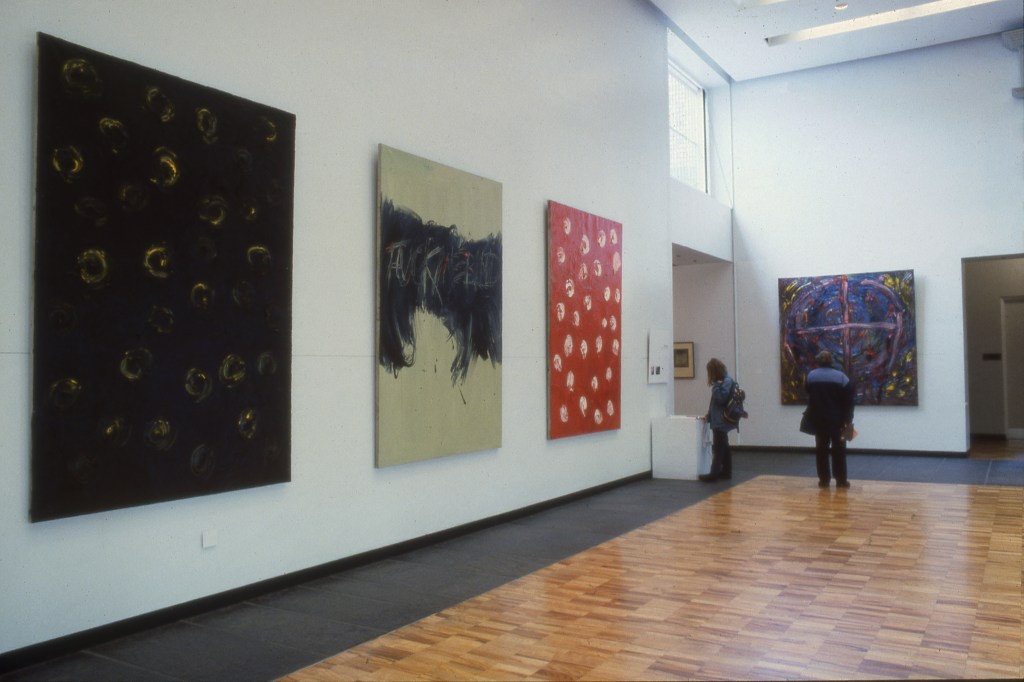
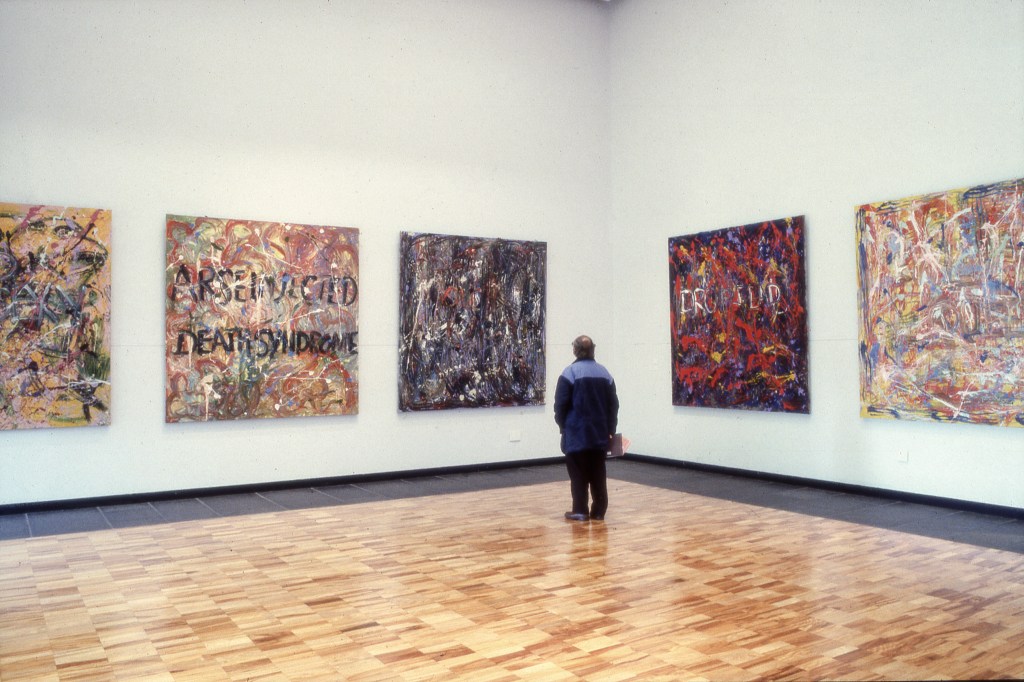
Images courtesy of The Whitworth, University of Manchester
It is equally significant that the exhibition was housed in Whitworth’s South Gallery, created in the late 1960s, which has a series of windows spilling light across the floor. As the then Director of the Whitworth Alistair Smith points out, the space resembles the refectory of Santa Maria delle Grazie in Milan, where Da Vinci’s Last Supper can be found. The South Gallery also vaguely echoes the architecture of Italian churches, where the walls would usually be decorated with scenes from the lives of saints or Christ’s Stations of the Cross. In turn, the South Gallery exhibited Jarman’s large canvases, drawing a subtle parallel between Christ’s Via Crucis and Derek Jarman’s last years living with AIDS while also covertly hinting at a dichotomy between sacred and profane.
Written by MA Art Gallery & Museum Studies Student, Marco Capicotto.
 Queering The Whitworth
Leave a comment