
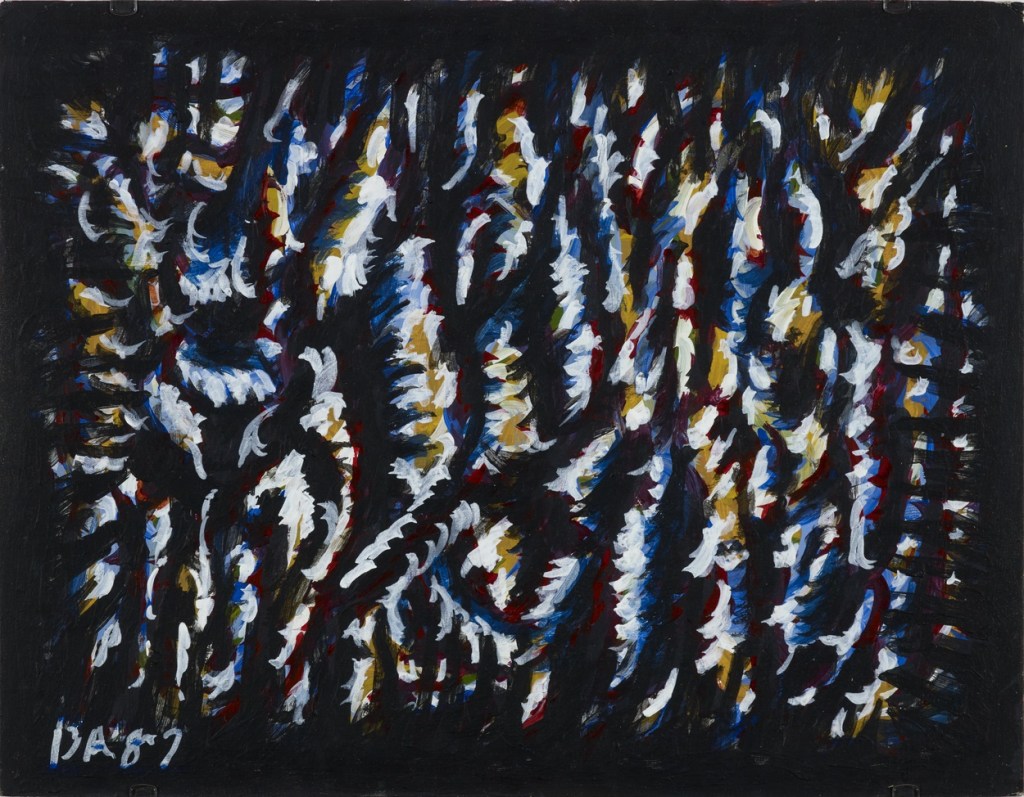
Pearl Alcock is an artist with a fascinating biography – an unsung hero who truly changed the community in which she was part of by giving London’s black gay community a sense of belonging within her shebeen.
Alcock came to Britain from Jamaica as part of the Windrush generation in 1958. Initially settling in Leeds, the artist worked in hospitality to save enough money to be able to move to Brixton, London. Arriving in Brixton in the 1960s, Alcock continued to work within hospitality in order to realise her dream of opening a clothes boutique. After working hard and saving her money she translated her passion for clothes and shoes onto the clothes rails of a small shop on Railton Road in Brixton. However, clothes were not the only thing that the artist would sell on the premises because downstairs in the basement, Alcock set up a shebeen, a shebeen being an illegal bar or club. Pearl’s shebeen became an anchor point for the black gay community of London, as often the black gay community would find themselves excluded from many of the other gay bars of London.
All this was to change however, when Alcock lost both her shop and the Shebeen when the Brixton riots occurred in the 1980s. It was at this point, strapped for cash but wanting to give a friend a birthday card, that she decided to make her friend a card instead. The birthday card received a great deal of attention from Alcock’s friends and it was at this point, aged 50, that art became a passion for her, drawing, colouring and painting images on the back of envelopes, card, boxes or pieces of board.
Alcock’s work was subsequently noticed by a local gallery and she was asked to display in an exhibition at the 198 Gallery on Railton Road. The exhibition was opened by the TV personality, singer and art collector, George Melley. Melley would go on to introduce Alcock to the art collector Monica Kinsley, who subsequently went on to support, collect and exhibit Pearl Alcock’s artwork all around the world.
Pearl Alcock died in 2006, leaving behind an archive of artworks – housed within the Whitworth collection, which reflects her identity as a black female Jamaican artist who, with open arms embraced black queerness in a celebration of the night.
 Queering The Whitworth
Leave a comment